White House Issues “Genesis Mission” Executive Order on AI
On November 24, 2025, the Trump Administration issued an Executive Order launching the “Genesis Mission”, a national initiative led by the Department of Energy (“DOE”) to accelerate AI-driven scientific discovery. This executive order occurs at a time when the European Union recently delayed or scaled back regulation of AI through revisions to the EU AI Act (as well as GDPR) in its omnibus package, while at the same time states have continued to introduce legislation to address AI while the federal moratorium on state AI laws has resurfaced.
Many thought leaders and policy analysts are framing this as one of the most ambitious US science and technology initiatives in decades, often comparing it to – as does the executive order itself – the Manhattan Project. The order intends to position AI as a national strategic asset, akin to nuclear technology during the Cold War, where AI becomes central to US global competitiveness and national security. Timelines are aggressive: DOE must identify 20 national science challenges within 60 days, and demonstrate initial operating capability within 270 days.
Advocates of the order promote benefits such as the acceleration of scientific discovery and the opportunities for public-private partnerships, while its critics remain concerned about sustained funding, and whether this will simply subsidize large AI firms – they note the order does not mention open source AI development sparking debate about whether it will favor incumbents like OpenAI, Anthropic, and Google. They also warn of data privacy, IP risk and other security implications around integrating proprietary data sets, managing IP rights, and the use of agentic AI.
Private Sector: Potential Impacts and Opportunities
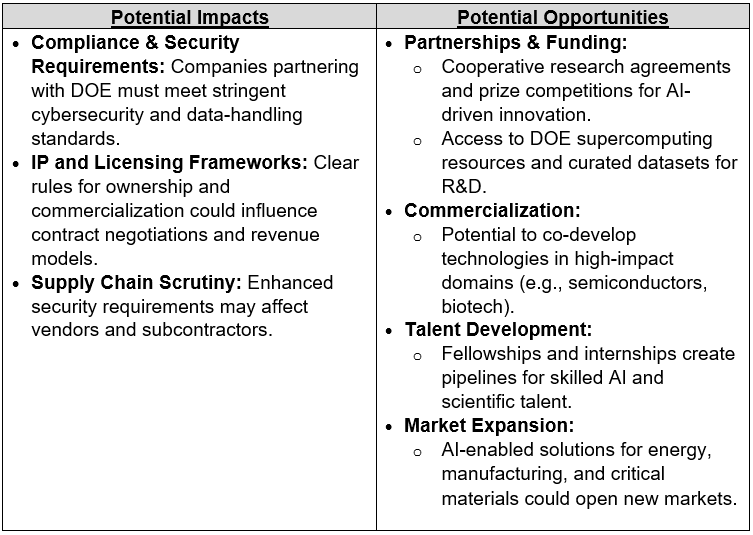
The bottom line? This order represents a “big bet” on AI-driven science and national leadership, with the potential to redefine US technological leadership. However, its success may hinge on several factors, including execution, funding, clarity, risk management, and balancing innovation with security and fairness.
A summary of the Executive Order’s key points is contained below:
1. Purpose and Vision
- To accelerate AI-driven scientific discovery to solve “the most challenging problems of this century”
- To build an integrated AI platform to harness Federal scientific datasets – to train scientific foundation models, and create AI agents to test new hypotheses, automate research workflows, and accelerate scientific breakthroughs
- Compares urgency to the Manhattan Project, emphasizing national security, energy dominance, and technological leadership.
2. Governance and Leadership
- Department of Energy (DOE) will implement the Mission and manage resources.
- Assistant to the President for Science and Technology (APST) will provide overall leadership and interagency coordination through the National Science and Technology Council (NSTC).
- DOE will establish and operate a secure, integrated platform with:
- High-performance computing (DOE supercomputers + secure cloud).
- AI modeling frameworks and domain-specific foundation models.
- Access to curated and synthetic datasets under strict security and IP protections.
- AI-augmented experimentation and manufacturing tools.
- 60 days from order – list challenges: Identify 20 national science and technology challenges of national importance spanning domains consistent with NST Memo 2 (Sept 23, 2025), including: (i) advanced manufacturing; (ii) biotechnology; (iii) critical materials; (iv) nuclear fission and fusion energy; (v) quantum information science; and (vi) semiconductors and microelectronics.
- 90 days from order – Identify needs/resources. DOE shall identify Federal computing storage and network resources available to support the mission (including DOE on-prem and cloud-based computing systems); and resources available through industry partners. DOE shall also identify any additional partnerships or infrastructure enhancement that could support the Platform’s computational foundation.
- 120 days of order – Identify initial data and model assets and develop a plan. Assets shall include digitalization, standardization, metadata and provenance tracking. Plan shall include “appropriate risk-based cybersecurity measures” for incorporating data sets from federal funded research, other agencies, academic institutions, and approved private-sector partners.
- 240 days of order – Review capabilities for robotic labs and production facilities with the ability to engage in AI-directed experimentation and manufacturing, including automated and AI-augmented workflows, and the related technical/operating standards needed.
- 270 days – Initial Demonstration. DOE shall “consistent with applicable law and subject to available appropriations” – demonstrate initial operating capability for at least one of the identified challenges.
- Advanced manufacturing, biotechnology, critical materials, nuclear energy, quantum information science, semiconductors/microelectronics.
- Encourages collaboration with industry, universities, and international partners.
- Standardized frameworks for IP, licensing, and commercialization.
- Competitive programs for research fellowships and internships.
- Strict cybersecurity, classification, and export-control measures.
- Vetting and authorization for non-Federal collaborators.
About Maynard Nexsen
Maynard Nexsen is a full-service law firm of 600+ attorneys in 31 locations from coast to coast across the United States. Maynard Nexsen formed in 2023 when two successful, client-centered firms combined to form a powerful national team. Maynard Nexsen’s list of clients spans a wide range of industry sectors and includes both public and private companies.